Have you ever considered how light affects your mood? Psychology suggests a warm glow can calm your mind and body, setting a snug environment. Similarly, our physiological reactions vary with different light intensities and shades. To harness this play of colors in your lighting, it’s crucial to understand the concept of ‘dim to warm’ and its functioning.
‘Dim to Warm’ is a lighting advancement that modifies the warm hue of white lights to simulate a candlelit ambiance. This technology dims lights by regulating the current flow. The essence of how ‘dim to warm’ operates is based on the light’s color temperature. As the intensity reduces, the color temperature drops, resulting in warmer white tones.
In this piece, I delve deeply into the nuances of ‘dim to warm,’ its operational principles, applications, and more. Let’s dive in:
What is Dim to Warm?
‘Dim to warm’ is a technique that tailors the warmth of white lights. One can achieve a spectrum of warm tones by tweaking the color temperatures.
These lights cast a golden to amber hue. Such ambient lighting is ideal for fostering a warm and inviting setting. Hence, ‘dim-to-warm’ solutions are increasingly popular for illuminating spaces like bedrooms, lounges, kitchens, and work areas.
Dim to Warm: How Does It Work?
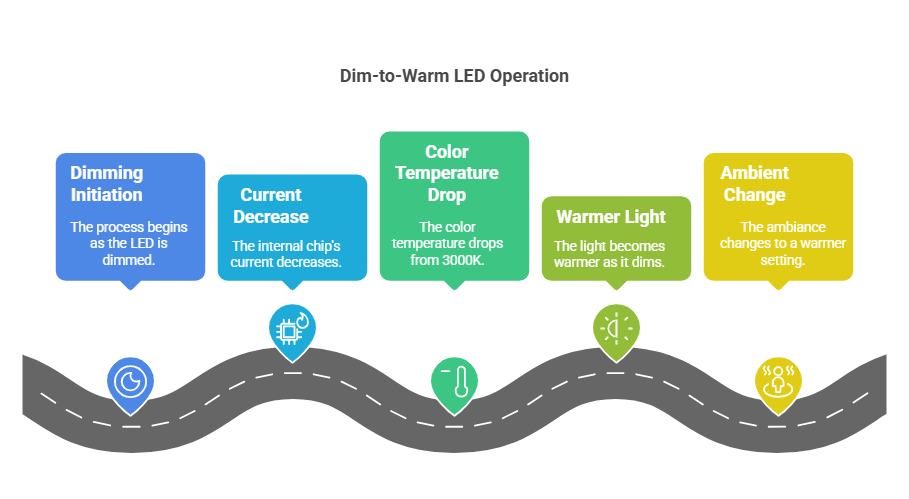
Have you ever observed a dimmable incandescent bulb in action? The principle behind dim-to-warm LEDs mirrors that of these bulbs. With traditional incandescent, dimming lowers the light intensity by reducing the current. But with dim-to-warm LEDs, the game changes. Dimming affects the light power and the color temperature, making it warmer.
| Color Temperature | Brightness | Appearance |
| 3000 K | 100% | Daylight white |
| 2700 K | 50% | Warm White |
| 2400 K | 30% | Extra Warm White |
| 2000 K | 20% | Sunset |
| 1800 K | 10% | Candlelight |
In this process, the color temperature transitions from 3000K to 1800K, producing varying shades of white. The highest color temperature corresponds to the brightest white. As the light is dimmed, the internal chip’s current decreases. Consequently, the color temperature drops, yielding a warmer illumination.
A glance at a chart would show that the color temperature also leads to a warmer ambiance as brightness goes down. Essentially, the dim-to-warm mechanism adjusts the color temperature to achieve this effect.
When it comes to dim-to-warm LED strips, there are two primary operational methods, each dependent on the chip’s design:
Dim-to-Warm LED Strip Without an IC Chip
These LED strips, devoid of an Integrated Circuit (IC) chip, combine red and blue chips to generate warm colors. In this setup, the blue-chip inherently has a higher color temperature than the red one. So, as the light dims, the blue chip’s voltage drops more rapidly, resulting in a warm light emission. A rich, warm glow is achieved by modulating the color temperature of both chips.
Dim-to-Warm LED Strip With IC Chip
For LED strips equipped with an independent chip (IC), the chip manages the current flow. This IC chip modifies the current when dimming occurs, lowering the color temperature. The outcome? A delightful, cozy, warm shade. Hence, these dim-to-warm LED strips exude warmth upon dimming.
Varieties of Dim-to-Warm LED Lights
There’s an array of dim-to-warm LED lighting options available. Here’s a breakdown:
- Dim-to-Warm Recessed Lighting Recessed lighting embedded in the ceiling offers a serene ambiance. Enhance this with dim-to-warm options, and you infuse a room with a sunny warmth reminiscent of natural sunlight.
- Dim-to-Warm LED Downlight This lighting option mimics the soft glow of a candle, perfect for homes or offices. Since these lights direct their illumination downward, they’re ideal for spotlighting specific areas in a space.
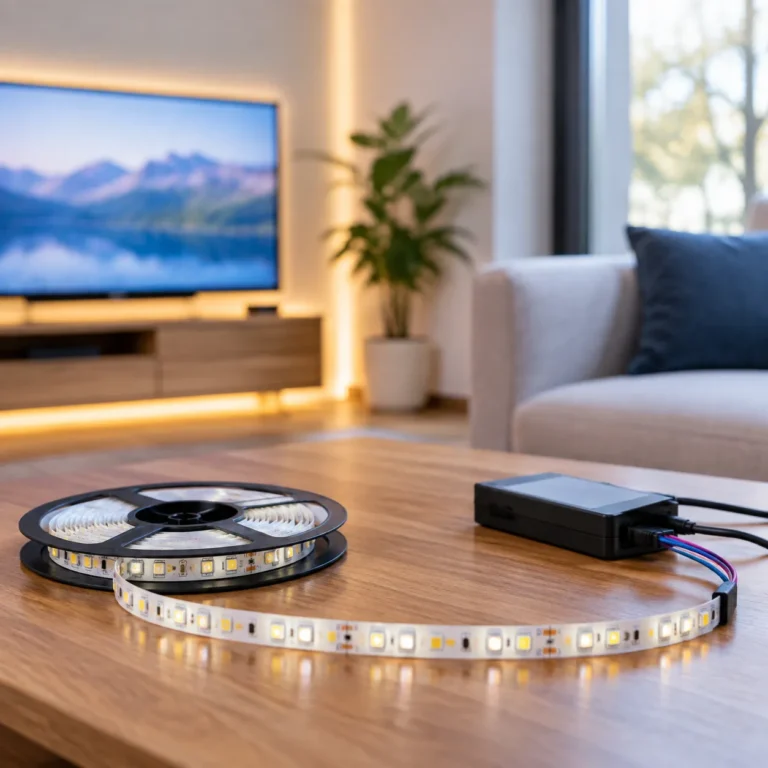
- Dim-to-Warm LED Strips These are flexible strips embedded with dimmable LED chips. The chips can adjust the light’s color temperature within a set spectrum, emanating warm white hues. These LED strips stand out for their adaptability among the array of dim-to-warm lights. They’re bendable, and you can tailor their length to your needs, making them perfect for accent, cabinetry, cove, or commercial lighting applications. Based on the internal diode or chip configuration, dim-to-warm LED strips are further categorized into:
- Dim-to-Warm SMD LED Strip: ‘SMD’ stands for Surface Mounted Devices. These strips house a multitude of LED chips within their circuit board. One pivotal aspect to consider is the chip density. A higher density means fewer visible hotspots. Thus, when opting for SMD LED strips, evaluate the chip density.
- Dim-to-Warm COB LED Strip: ‘COB‘ signifies Chip On Board. These strips feature multiple LED chips bonded directly onto a pliable circuit board, acting as a cohesive unit. Notably, these strips avoid creating hotspots, delivering consistent, dot-free illumination.
Versatile Dim to Warm LED Bulbs
The dim to warm LED bulbs are both durable and cost-effective and available in various sizes. They offer a unique opportunity to enhance the ambiance of any interior space with their aesthetic appeal. Hence, explore the diverse range of dim to warm LED lighting options and select the one that aligns with your preferences.
Insights into Dim to Warm LED Strips
One must familiarize oneself with some key details for a comprehensive understanding of dim to warm LED strips. Below are some pivotal points for your reference:
Color Temperature
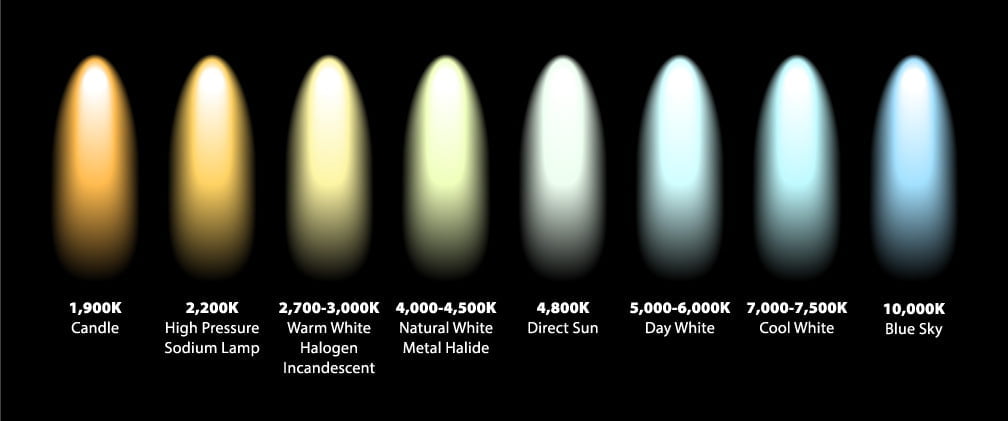
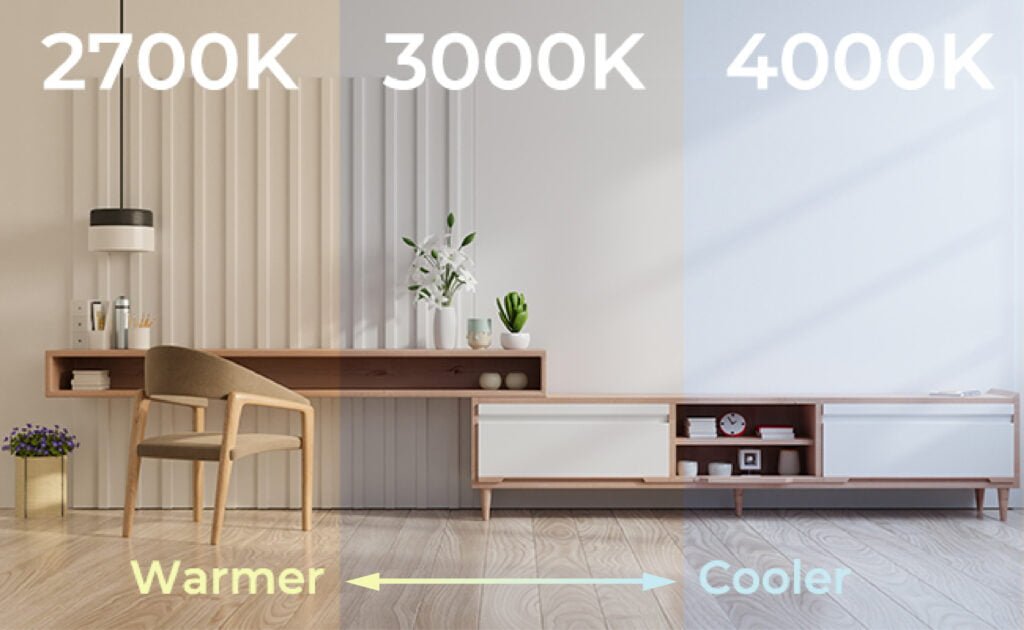
When setting up a dim to warm LED strip, the color temperature (often indicated as the CCT rating) is paramount. CCT, which stands for Correlated Color Temperature, is denoted in Kelvin. The color temperature spans between 3000K and 1800K for dim to warm variants. A lower color temperature equates to a warmer hue. Unsure about the ideal temperature for your lighting endeavor? Rest assured, you can adjust these temperatures to match your desired ambiance. Here are some recommended CCT ranges for general lighting scenarios:
Guidelines for Dim to Warm Settings:
| Area | CCT Range |
| Bedroom | 2700K |
| Bathroom | 3000K |
| Kitchen | 3000K |
| Dining Room | 2700K |
| Working Space | 2700K/3000K |
An orangish, warm hue offers a cozy ambiance for the bedroom and dining spaces. A 2700 K light suits these areas best. Meanwhile, a warm-yellow light of 3000K fits best for functional rooms like the kitchen and bathroom. You can choose 2700K or 3000K for your workspace, depending on your visual comfort.
Dimming Power Supply
Ensure the dimming supply matches the dim-to-warm LED strip. For instance, a dim-to-warm LED strip with a red-blue chip mix needs a voltage-regulated dimmer, while one with IC chips aligns with PWM output dimming. If deciding between these two, the IC chip variant is preferable since its PWM-dimming power supply is easy to find.
Strip Length
When purchasing dim-to-warm LED strips, be aware of the length. The standard size is usually 5m. However, MyLikeLed provides tailored length adjustments on all their LED strips. Reach out for personalized dim-to-warm LED strip options.
LED Density
The density of these strips influences the lighting appearance. A high-density LED strip provides a superior glow by avoiding hotspots. MyLikeLed’s dim-to-warm LED strips come in thicknesses of 224 LEDs/m or 120 LEDs/m.
CRI Rating
The Color Rendering Index (CRI) evaluates color accuracy. A higher CRI rating implies better color clarity. Always aim for a CRI above 90 for optimal color representation.
Flexible Dimensions
Dim-to-warm LED strips should support versatile sizing. MyLikeLed offers a minimal cutting length of 62.5mm, ensuring flexible adjustments. Contact MyLikeLed to get the best LED solutions for your needs.
LED Chip Size
The dimension of LED chips affects the brightness of dim-to-warm lights. Larger chips produce more vibrant illumination. For example, an SMD2835 (2.8mm x 3.5mm) LED emits a broader glow than an SMD2216 (2.2mm x 1.6mm). Choose according to your lighting needs.
Installation Ease
Dim-to-light LED strips are equipped with high-quality 3M adhesive tape for hassle-free installation, ensuring they stay on any surface.
IP Rating
The Ingress Protection (IP) rating gauges an LED strip’s resilience against various elements. It indicates if the strip resists dust, heat, or water. For instance, an IP65-rated LED strip resists dust and water but isn’t submersible. Conversely, an IP68-rated strip can be immersed in water.
Voltage Concerns
Longer strips can lead to increased voltage drop, impacting efficiency. A thicker Printed Circuit Board (PCB) can counter this drop. MyLikeLed maintains a PCB thickness of 2oz, ensuring the strips remain cool and voltage drop minimal.
Advantages of Dim to Warm Lighting
“Dim to Warm” lighting, also known as “Warm Dimming,” is a feature in some LED lighting products where the color temperature of the light becomes warmer as the brightness is reduced. This mimics the behavior of traditional incandescent bulbs, which naturally produce a warmer glow as they are dimmed. Here are some advantages of Dim to Warm lighting:
- Natural Ambiance: As the light dims, it produces a warmer, cozier glow reminiscent of sunset or candlelight. This can help create a relaxed and comfortable environment.
- Mimics Incandescent Behavior: Many people are accustomed to the warm glow that incandescent produce as they are dimmed. Dim to Warm lighting in LEDs provides a similar experience, making the transition from incandescent to LEDs smoother for users.
- Supports Circadian Rhythms: Warmer light in the evenings can help our body’s natural circadian rhythms. Blue-rich white light can suppress melatonin production, which is essential for sleep. By reducing the color temperature in the evenings, Dim to Warm lighting can help promote better sleep patterns.
- Flexibility in Mood Setting: Allows versatility in creating different moods in a space. Brighter, more excellent light is energizing and ideal for tasks, while dimmed, warmer light is calming and suitable for relaxation or socializing.
- Enhanced Aesthetic Appeal: In design-centric spaces, adjusting brightness and color temperature can be pivotal in achieving the desired aesthetic or ambiance.
- Energy Efficiency: While the primary goal of Dim to Warm technology is not energy saving, dimming lights inherently saves energy. With LEDs’ energy-efficient nature, users get both ambiance and efficiency.
- Prolonged LED Lifespan: Dimming LEDs generally can extend their lifespan. Since they’re not continually operating at full power, the wear and tear on the diodes are reduced.
- Less Visual Fatigue: Cooler, brighter lights can cause more visual fatigue over extended periods. By transitioning to a warmer hue, especially during the evening, Dim to Warm lighting can reduce eye strain.
- Compatibility: Many to Warm LED solutions are designed to be compatible with existing dimmer switches, making integration into current lighting systems straightforward.
- Innovation in Lighting Design: For architects and interior designers, Dim to Warm technology provides an additional tool in their palette, allowing for more innovative and adaptive lighting designs.
Uses of Dim to Warm LED Strips
Dim to warm LED technology has diverse applications. Below are some prevalent uses of this innovative lighting:
- Accent Lighting: Dim-to-warm LED strips can accentuate the features of any room element. Such strips are perfect for accent lighting, whether under staircases or along walls, offering a soft ambient touch.
- Cabinet Lighting: These LED strips can be positioned above or beneath cabinets for a refined appearance. Moreover, lights underneath cabinets enhance functional visibility, like under a kitchen cabinet, illuminating the workspace below.
- Shelf Lighting: Whether a bookshelf, apparel shelf, or shoe rack, dim to warm LED strips can elevate their visual appeal.
- Cove Lighting: Cove lighting, ideal for indirect lighting, can be achieved using dim to warm LED strips along ceilings. This arrangement can infuse warmth into bedrooms or living spaces.
- Lobby Lighting: Whether in a hotel or office lobby, the soft hues of dim to warm LED strips can impart a classy touch to your interior.
- Toe Kick Lighting: Illuminate your bathroom or kitchen floors with toe kick lighting. Opting for dim to warm LED strips is judicious, offering flexible color temperature adjustment.
- Background Lighting: Dim-to-warm LED strips are perfect for backlighting monitors or highlighting art pieces. Placing them behind mirrors can enhance your vanity space.
- Commercial Lighting: These LED strips are ideal for commercial spaces like restaurants, hotels, or retail stores. They set a welcoming mood with their snug glow, drawing in patrons.
Feel free to tap into your creative side with myriad other potential uses.
Different Kinds of Dimmers
A dimmer plays an integral role in the functioning of dim-to-warm LEDs by regulating the light’s current flow. One needs a suitable dimmer to manage the light intensity or its color temperature effectively. Here’s a concise guide on the prevalent dimmer types:
- Dial Dimmer: A nod to traditional dimming systems, dial dimmers come equipped with a dial. By rotating this dial, users can seamlessly adjust the light’s brightness.
- CL-Type Dimmer: Originating from the initials ‘C’ for CFL bulbs and ‘L’ for LEDs, CL dimmers cater to these specific bulb types. Typically designed with a lever or a switch, they offer straightforward lighting control.
- ELV-Type Dimmer: Short for Electronic Low Voltage, ELV dimmers are tailored for low-voltage halogen lighting. They achieve the dimming effect by modulating the light’s power supply.
- MLV-Type Dimmer: Magnetic Low Voltage (MLV) dimmers are designated for fixtures with a low voltage. Their unique feature is the magnetic driver that facilitates the dimming.
- 0-10V Dimmer: The 0-10V dimmer operates on a simple principle: the light’s intensity reduces when the voltage drops from 10V to 0V. Thus, at 10 volts, you’ll experience peak brightness, which then dims entirely at 0 volts.
- Smart Dimmers: Representing the latest in dimming technology, smart dimmers provide unparalleled convenience. Their prime advantage lies in remote or smartphone-based control.
Dim to Warm and Tunable White – Are They Identical?
While both dim to warm and tunable white involve white variations, mixing them up is easy. Despite the similarities in their appearance, they have distinct differences. Here’s a breakdown of their contrasting features:
With this knowledge, it’s clear that dim to warm and tunable white is unique. The former exclusively offers warm hues, while the latter spans the spectrum from friendly to cool shades. Furthermore, tunable white provides a broader range of color adaptability than dim to warm, also reflected in its higher price.
| Dim To Warm | Tunable White |
| Dim to warm LED strips bring out only the warm shades of white. | Tunable white LED strips can emit warm to cool shades of white. |
| The color temperature for dim to warm LED strips ranges from 3000 K to 1800 K. | The range in tunable white LED trips is from 2700 K to 6500 K. |
| It has a pre-set color temperature. | You can choose any temperature that falls into the range. |
| The highest temperature is the brightest shade for dim to warm. | The brightness of the light doesn’t depend on color temperature. That is, you can control the brightness of each shade. |
| Dim to warm are connected to dimmer. | It requires a connection to a tunable white LED controller for color changing. |
What Does a Dim-to-Warm Light Look Like Without Dimming?
When not adjusted, dim to warm lights resemble conventional LED bulbs. Their distinct characteristic emerges when dimmed, giving off a cozy, yellowish glow. On the other hand, standard LEDs typically emit a bluish or neutral white light. Besides this, there’s a little visual distinction between regular and dim to warm bulbs.
Conclusion
Dim to Warm technology is a remarkable innovation for manipulating warm light tones. It allows users to craft an inviting ambiance using adjustable color temperatures. Enhance your interior aesthetics by choosing dim to warm lighting solutions.
If you’re searching for regular or bespoke dim-to-warm LED strips, MyLikeLed has you covered. We pride ourselves on offering top-quality PWM and COB dim to warm LED strips. Moreover, we cater to custom requests, ensuring your LED strips meet your exact specifications regarding length, CRI, color, and more. Reach out to us today!

Hi, I’m Xylia Xiong, a sales professional with 14 years of experience in the LED strip light industry. I specialize in providing tailored solutions, leveraging my expertise in LED products and the latest industry trends. Known for effective communication and problem-solving, I’m dedicated to helping lighting manufacturers, importers, and distributors achieve their goals.
Let’s work together to create customized solutions that exceed expectations.